
Community-Centered Just Energy Transition in Nigeria: Policy Pathways for Inclusive Critical Minerals Governance and Sustainable Development
Technical Writing Team
Mohd Yusoff Ishak (Chair, Malaysia), Mohammad Hadi Ahmad (Nigeria), Dessalegn Obsi Gemeda (Ethiopia), Ahmed Abubakar (Nigeria), Caroline Mulinya (Kenya), Mitiku Badasa Moisa (Ethiopia), Ishmael Lente (Ghana), Siriki Fané (Mali), Kamal Yusuf (Nigeria), Buhari Lawan Muhammad (Nigeria), Zenebe Reta Roba (Ethiopia), Safiya Yakubu Salihu (Nigeria), Zebenay Niguse Ayele (Ethiopia), Samir Shehu Danhassan (Nigeria), Sahal Muhammad Inuwa (Nigeria), Aminu Sulaiman Zangina (Nigeria), Maman Banani (Niger), Bahiru Haile Aboye (Ethiopia), Mukhtar Suleiman (Nigeria), Wakjira Takala Dibaba (Ethiopia), Mehmet Ali Çelik (Türkiye), Melahat Batu Ağırkaya (Türkiye), Fedhasa Benti Chalchissa (Ethiopia), Tekalign Abdisa (Ethiopia). Tadesse Mosissa Ejeta (Ethiopia), Biratu Bobo Merga (Ethiopia), Gebeyanesh Worku Zerssa (Ethiopia), Yideneku Gosaye Gudeta (Ethiopia), Tena Regasa Duresa (Ethiopia), Tekalign Tadesse (Ethiopia), Fekadu Tamiru Gebissa (Ethiopia), Tolera Megersa Gudeta (Ethiopia), Mengistu Muleta Gurmessa (Ethiopia), Teka Bekuma Abdisa (Ethiopia), Indale Niguse Dejene (Ethiopia), Kiros Tsegay Deribew (Ethiopia), and Mosissa Geleta Erena (Ethiopia).
Core Writing Team
Policy Brief
SESPS LAB
Edited by
Ahmed Abubakar
Executive Director, SESPS LAB
Technical Support Unit
Mohammad Hadi Ahmad
Dessalegn Obsi Gemeda
This policy brief should be cited as:
SESPS Lab. (2026). Community-Centered Just Energy Transition in Nigeria: Policy Pathways for Inclusive Critical Minerals Governance and Sustainable Development. Social-Ecological Systems, Policy & Strategy Lab (SESPS Lab) Policy Brief No. 2. Dutse, Nigeria, pp. 1-12
Policy Brief – N° 02 – March 2026
© SESPS Lab, 2026. All rights reserved
Context
The global transition from fossil fuel-based energy systems to renewable and low-carbon alternatives is accelerating (Kabeyi and Olanrewaju, 2022). The use of renewable and low-carbon alternatives significantly contributes to economic growth, accessibility to clean energy, and minimizing the impacts of climate change. This development is driven by the urgent need to address climate change, enhance energy security, and achieve the objectives of the Paris Agreement and the Sustainable Development Goals (SDGs) (Gan et al., 2023). This transition has substantially increased global demand for critical minerals, including lithium, cobalt, graphite, nickel, manganese, and rare earth elements, which are indispensable components of clean energy technologies such as electric vehicles, battery storage systems, wind turbines, solar photovoltaic panels, and modern electricity grids (Mahnoor et al., 2005; Berahab, 2022). As countries compete to secure sustainable and resilient supply chains for these strategic minerals, resource-rich developing economies have an unprecedented opportunity to leverage their mineral wealth to promote inclusive economic growth and sustainable development (Figure 1).
Nigeria is well positioned to benefit from this emerging global market due to its abundant deposits of critical minerals, including lithium, tin, columbite, tantalite, graphite, gold and rare earth elements distributed across several states (Olade, 2021; Onyealisi, 2025; Olade, 2025). The country’s growing commitment to economic diversification, industrialization, and energy transition further highlights the strategic importance of developing a well-governed critical minerals sector. If managed effectively, these resources can stimulate domestic value addition, create quality employment, strengthen local industries, increase government revenues, and contribute to achieving national climate and development objectives. However, the rapid expansion of mineral extraction also presents significant governance challenges that require urgent policy attention.
Historically, extractive industries in many developing countries have been associated with environmental degradation, land-use conflicts, displacement of local populations, inadequate compensation, weak regulatory oversight, and limited benefit sharing with host communities (Hilson, 2002; Tagliarino et al., 2018; Fayomi et al., 2024). In Nigeria, artisanal and small-scale mining, illegal mining activities, weak institutional coordination, environmental pollution, and insufficient community participation continue to undermine the sustainable management of mineral resources. Without deliberate reforms, the global demand for critical minerals could exacerbate existing inequalities, intensify social tensions, and undermine the principles of environmental justice and sustainable development.
A community-centered, just energy transition provides a practical framework for addressing these challenges by ensuring that the benefits and costs of the transition are shared equitably among all stakeholders. At its core, a just transition emphasizes inclusive governance, respect for human rights, environmental stewardship, transparency, gender equality, decent work, and meaningful participation of affected communities in decision-making processes (Olawuyi et al., 2025). Rather than treating host communities as passive recipients of development interventions, this approach recognizes them as strategic partners whose knowledge, priorities, and rights are fundamental to achieving socially equitable and environmentally sustainable resource governance.
This policy brief examines the opportunities and governance challenges associated with Nigeria’s critical minerals sector within the broader context of the global energy transition. It synthesizes current evidence, identifies institutional and policy gaps, and proposes practical, actionable policy pathways for strengthening community participation, improving transparency and accountability, enhancing environmental safeguards, promoting equitable benefit-sharing mechanisms, and promoting sustainable local economic development. The recommendations are designed to support policymakers, development partners, civil society organizations, mining companies, and community leaders in developing governance systems that align national development priorities with internationalcommitments on climate action, human rights, and responsible mineral resource management.
The scope of this policy brief encompasses the governance of critical minerals throughout the mining value chain from exploration and licensing to extraction, processing, environmental management, community engagement, revenue management, mine closure, and post-mining land restoration. It also considers cross-cutting issues such as gender inclusion, youth empowerment, artisanal and small-scale mining formalization, climate-smart mining practices, and institutional capacity strengthening. Thus, promoting a community-centered approach to critical minerals governance, this policy brief aimed to provide a strategic roadmap for ensuring that Nigeria’s contribution to the global clean energy transition delivers long-term economic prosperity, environmental sustainability, and social justice for present and future generations.
Current Situation
The accelerating global transition to clean energy has fundamentally reshaped international demand for critical minerals, positioning mineral-rich developing countries as key actors in the emerging green economy. Critical minerals, including lithium, cobalt, graphite, nickel, manganese, tin, and rare earth elements, are essential inputs for renewable energy technologies, battery storage systems, electric vehicles, hydrogen technologies, and modern electricity infrastructure (Tyagi et al., 2023; Mahnoor et al., 2025). As governments and industries seek secure and sustainable supply chains, competition for access to these strategic resources has intensified, creating new economic opportunities for countries (including Nigeria) with substantial mineral reserves.
Nigeria possesses significant deposits of several critical minerals distributed across states such as Nasarawa, Plateau, Kaduna, Kogi, Niger, Kebbi, Zamfara, Bauchi, and Oyo. In recent years, the federal government has prioritized the revitalization of the solid minerals sector as part of broader efforts to diversify the economy away from oil dependence (Ndiomaluke et al., 2025). Policy reforms, increased investor interest, and growing international partnerships have further elevated the strategic importance of the mining sector in supporting national industrialization, job creation, export diversification, and implementation of Nigeria’s Energy Transition Plan.
Despite these opportunities, the governance of critical minerals remains constrained by persistent institutional, environmental, and socio-economic challenges (Table 1). Artisanal and small-scale mining continues to dominate mineral production in many regions, often operating outside formal regulatory frameworks. Illegal mining, weak enforcement of environmental regulations, inadequate geological data, overlapping institutional mandates, limited local processing capacity, and insufficient investment in mining infrastructure continue to reduce the sector’s overall contribution to sustainable development. Furthermore, many host communities experience environmental degradation, banditry, loss of agricultural land, water contamination, occupational health risks, and limited access to the economic benefits generated from mineral extraction.
Community participation in mineral governance also remains inadequate. Decision-making processes surrounding mineral licensing, environmental assessments, compensation arrangements, and community development projects frequently provide limited opportunities for meaningful engagement by affected populations. Women, youth, Indigenous groups, and other marginalized stakeholders are often underrepresented in governance processes despite bearing a disproportionate share of mining-related social and environmental impacts. These governance deficiencies undermine public trust, increase the likelihood of conflicts between mining operators and host communities, and threaten the long-term sustainability of mineral development.
Policy Gaps
Although Nigeria has enacted important legislation and policy frameworks governing the mining sector, including the Minerals and Mining Act, environmental regulations, and national development strategies, these instruments were largely designed before the rapid expansion of global demand for critical minerals associated with the clean energy transition. Consequently, they do not comprehensively address emerging issues such as responsible critical minerals governance, supply-chain due diligence, climate-smart mining, circular economy approaches, responsible sourcing standards, or community-centered benefit-sharing mechanisms.
Several critical policy gaps persist:
- Limited integration between mining, energy transition, climate change,
environmental protection, and local development policies. - Weak institutional coordination among federal, state, and local government agencies responsible for mining governance.
- Inadequate legal provisions guaranteeing meaningful community participation and Free, Prior, and Informed Consent (FPIC) throughout the mining lifecycle.
- Weak monitoring and enforcement of environmental and social safeguards, including mine rehabilitation and biodiversity protection (Table 2).
- Limited transparency in mineral licensing, revenue management, and allocation of benefits to host communities.
- Insufficient formalization and technical support for artisanal and small-scale mining operations.
- Inadequate investment in local mineral beneficiation, value addition, research, innovation, and workforce development.
- Absence of comprehensive monitoring and evaluation systems to assess social, environmental, and economic outcomes of critical mineral development.
These governance deficiencies increase the risk that expanding critical mineral extraction could reproduce patterns commonly associated with the “resource curse,” including environmental degradation, social exclusion, corruption, community conflict, banditry, and unequal distribution of economic benefits.
Why Action Is Needed
The next decade presents a unique opportunity for Nigeria to position itself as a leading supplier of responsibly sourced critical minerals while advancing national objectives for economic diversification, industrialization, climate resilience, and sustainable development. However, achieving these objectives requires governance reforms that place affected communities at the center of decision-making and ensure that mineral development generates broad-based social and economic benefits.
Failure to strengthen governance frameworks could undermine investor confidence, increase environmental liabilities, intensify community grievances, and reduce Nigeria’s competitiveness in international markets where environmental, social, and governance (ESG) performance increasingly influences investment decisions and market access. Conversely, adopting a community-centered just energy transition framework can enhance transparency, improve environmental stewardship, promote social inclusion, strengthen local livelihoods, and build resilient institutions capable of supporting sustainable mineral development.
Urgent policy action is therefore required to modernize Nigeria’s critical minerals governance architecture, strengthen institutional coordination, formalize artisanal mining, promote responsible investment, safeguard human rights, and establish equitable benefit-sharing mechanisms that ensure host communities become active partners in the country’s transition to a low-carbon economy (Table 3). Thereby aligning national policies with international best practices and emerging global standards for responsible mineral governance, Nigeria can transform its critical mineral resources into a catalyst for inclusive economic growth, environmental sustainability, and long-term national prosperity.
Table 1. Key Challenges to Community-Centered Just Energy Transition and Inclusive Critical Minerals Governance in Nigeria. (See attached PDF)
Table 2. Monitoring, Evaluation, and Learning (MEL) Framework for Community-Centered Just Energy Transition and Inclusive Critical Minerals Governance in Nigeria. (See attached PDF)
Table 3. Policy Implementation Matrix for Community-Centered Just Energy Transition and Inclusive Critical Minerals Governance in Nigeria. (See attached PDF)
Key message
- Strengthen governance to ensure transparent, accountable, and sustainable
- management of Nigeria’s critical minerals.
- Empower host communities through inclusive decision-making, equitable
- benefit sharing and respect for human rights.
- Protect the environment by enforcing strong safeguards, responsible mining
- practices, and mine rehabilitation.
- Promote local value addition by formalizing artisanal mining, creating jobs,
- and expanding domestic mineral processing.
- Enhance implementation through coordinated institutions, sustainable
- financing and effective monitoring and evaluation.
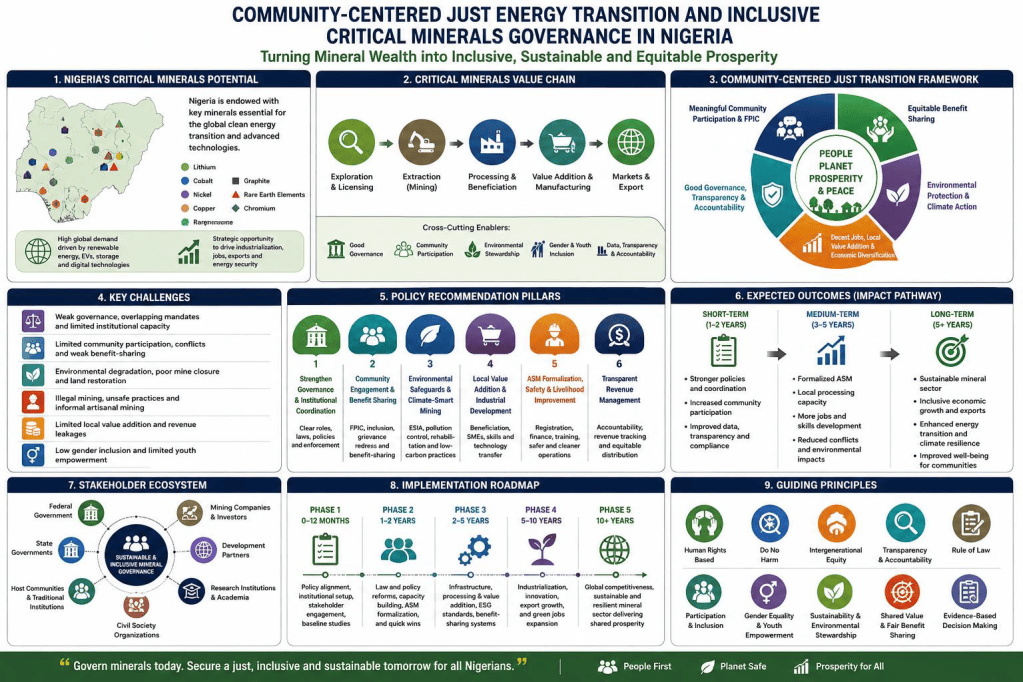
Figure 1: Conceptual framework for a community-centered just energy transition in Nigeria, illustrating the critical minerals value chain, governance priorities, key implementation challenges, stakeholder roles, policy pillars, implementation roadmap, expected outcomes, and guiding principles for achieving inclusive, transparent, and sustainable critical minerals governance
Conclusions
Nigeria, the most populous country in Africa, stands at a pivotal moment in the global energy transition. Its abundant critical mineral resources provide a unique opportunity to drive economic diversification, industrial development, job creation, sustainable development, and climate-resilient growth. However, realizing these benefits depends on establishing governance systems that are transparent, inclusive, environmentally responsible, and community-centered. Without targeted reforms, the expansion of critical mineral extraction risks exacerbating environmental degradation, social inequalities, and governance challenges, thereby limiting the country’s ability to benefit from the growing global demand for responsibly sourced minerals. A community-centered just energy transition provides a practical pathway for balancing economic development with environmental sustainability and social equity. Thus, strengthening institutional coordination, ensuring meaningful community participation, formalizing artisanal and small-scale mining, promoting local value addition, safeguarding environmental and human rights standards, and improving transparency and accountability, Nigeria can transform its critical minerals sector into a driver of inclusive and sustainable development. Achieving this vision requires immediate and coordinated action by government, the private sector, civil society, development partners, research institutions, and host communities. Policymakers should prioritize the development of an integrated critical minerals governance framework that aligns with national development priorities and international best practices. Mining companies should adopt responsible business practices that respect human rights, protect the environment, and promote equitable benefit-sharing. Development partners should provide technical assistance, capacity building, and innovative financing to support governance reforms and community development initiatives. Communities should be recognized as equal partners in decision-making and empowered to participate throughout the mining value chain. Therefore, acting now, Nigeria can position itself as a regional leader in responsible critical minerals governance, strengthen its contribution to the global clean energy transition, and ensure that the benefits of its mineral wealth are shared equitably among present and
Abbreviations
- AfDB – African Development Bank
- ASM – Artisanal and Small-Scale Mining
- CSO – Civil Society Organization
- EIA – Environmental Impact Assessment
- EITI – Extractive Industries Transparency Initiative
- ESG – Environmental, Social and Governance
- FPIC – Free, Prior and Informed Consent
- FGN – Federal Government of Nigeria
- FMEnv – Federal Ministry of Environment
- FMSMD – Federal Ministry of Solid Minerals Development
- GCF – Green Climate Fund
- GDP – Gross Domestic Product
- GHG – Greenhouse Gas
- ICMM – International Council on Mining and Metals
- ICPC – Independent Corrupt Practices and Other Related Offences Commission
- IEA – International Energy Agency
- LGA – Local Government Area
- M&E – Monitoring and Evaluation
- NEITI – Nigeria Extractive Industries Transparency Initiative
- NESREA – National Environmental Standards and Regulations Enforcement Agency
- NBS – National Bureau of Statistics
- NGO – Non-Governmental Organization
- PPP – Public–Private Partnership
- SDGs – Sustainable Development Goals
- SME – Small and Medium-sized Enterprise
- SMEDAN – Small and Medium Enterprises Development Agency of Nigeria
- TETFund – Tertiary Education Trust Fund
- UNDP – United Nations Development Programme
- UNEP – United Nations Environment Programme
- UNFCCC – United Nations Framework Convention on Climate Change
- WBG – World Bank Group
References
- Berahab, R. (2022). The energy transition amidst global uncertainties: A focus on critical minerals. Policy Brief, 37(22), 1-12.
- Fayomi, O. O., Adigun, O. W., & Zubair, Z. A. (2024). New Models for Eradicating Unsustainable Exploitation of Extractive Resources and Its Impact on the Host Communities in Nigeria. Journal of Sustainable Development Law and Policy (The), 15(3), 197-221.
- Gan, K. E., Taikan, O., Gan, T. Y., Weis, T., Yamazaki, D., & Schüttrumpf, H. (2023). Enhancing renewable energy systems, contributing to the sustainable development goals of the United Nations, and building resilience against climate change impacts. Energy Technology, 11(11), 2300275.
- Hilson, G. (2002). An overview of land use conflicts in mining communities. Land use policy, 19(1), 65-73. Kabeyi, M. J. B., & Olanrewaju, O. A. (2022). Sustainable energy transition for renewable and low-carbon grid electricity generation and supply. Frontiers in Energy research, 9, 1-45
- Mahnoor, M., Chandio, R., Inam, A., & Ahad, I. U. (2025). Critical and strategic raw materials for energy storage devices. Batteries, 11(4), 163.
- Mahnoor, M., Chandio, R., Inam, A., & Ahad, I. U. (2025). Critical and strategic raw materials for energy storage devices. Batteries, 11(4), 163.
- Ndiomaluke, C., Obi, C., Orajaka, U., Ejefobihi, U., & Percy, N. (2025). Economic diversification strategies for sustainable development in Nigeria. Journal of Policy and Development Studies, 18(3), 1-23.
- Olade, M. (2021). Overview of Nigeria’s Mineral Resources in the Context of Africa’s Mineral Wealth.
- Olade, M. A. (2025). Lithium geo-resources in pan-African pegmatites of Nigeria: an evaluation of their geological and geochemical characteristics and implications for mineral exploration. Global Journal of Pure and Applied Sciences, 31(2), 139-171.
- Olawuyi, D., Bright, C., Goethals, S., & Hasan, Q. (2025). Beyond just transition: Advancing responsible and rights-based business practices in the energy and extractives sector. Business and Human Rights Journal, 10(1), 1-10. Onyealisi, O. J. (2025).
- Point Pattern Analysis of Mineral Occurrences in Nigeria. Insights for Ore Deposit Genesis (Master’s thesis, Universidade de Evora (Portugal)).
- Tagliarino, N. K., Bununu, Y. A., Micheal, M. O., De Maria, M., & Olusanmi, A. (2018). Compensation for expropriated community farmland in Nigeria: An in-depth analysis of the laws and practices related to land expropriation for the Lekki Free Trade Zone in Lagos. Land, 7(1), 23.
- Tyagi, A., Warrior, D., Ganesan, K., Jain, R., Chandhok, V., Dasgupta, A., … & Mandal, T. (2023). Addressing Vulnerabilities in the Supply Chain of Critical Minerals.

